


House of Europe

The European Union has been supporting the Ukrainian cultural sector for many years. A large number of institutions, initiatives, platforms, companies and individuals work every day to provide opportunities for creative people in the field of culture and education, as well as to build bridges between Ukraine and Europe. One of these projects is House of Europe. In December 2023, we had the opportunity to talk to them about their activities.
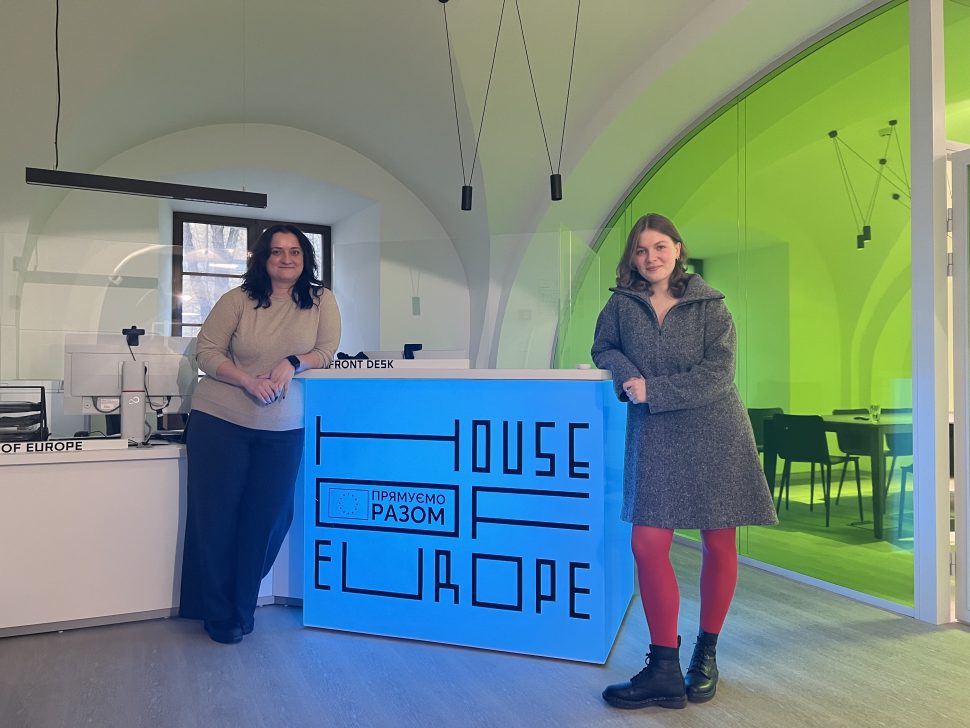
Franziska Simon – Head of Programme
Ilona Demchenko – Manager International Cooperation and Infrastructure Grants
E-mail: ask@houseofeurope.org.ua
Address: Vul. Lavrska 16 L, 01015 Kyiv, Ukraine
What is House of Europe?
Franziska Simon: House of Europe is an EU-funded project that started in 2019 and since then has been implemented by Goethe-Institut Ukraine. It aims to connect Ukrainians working in the fields of culture, education, creative industries, media youth and social entrepreneurship with their colleagues in the EU, foster professional and creative exchange and build up capacities for people working in these fields. To my knowledge, in 2019 it was the biggest project dedicated to support culture, creative industries and education that the EU ever initiated outside of the EU.
What was the concept at the beginning and how has it been modified over time?
Ilona Demchenko: There was a programme called Culture Bridges that was launched in 2015/16 by the British Council and that offered grant funding and capacity building for the cultural and creative sector in Ukraine when the conversations about Ukraine strengthening ties with Europe became more concrete. It was the first major support programme for Ukrainian cultural projects. When we started developing House of Europe, we drew on the experience gained from the Cultural Bridges programme.
Ilona emphasizes that House of Europe has learned a lot about the needs of its target group over time. Accordingly, the project has constantly evolved in response to feedback from the grantees and participants.
Ilona: The project can and does adapt, and I think this flexibility is a great strength.
Franziska: Over the years, we were able to build up a structure that allows for flexibility. When Covid came the project used its structures to deal with the situation and this also helped us after the 24th of February 2022. For example, we were able to repurpose 1.5 Mill EUR funding for emergency support for our partners and target groups.
How did House of Europe change after Russia’s escalation of the war?
Ilona: The thing is that this project is funded by the EU. EU-funding programs are not known for being very flexible and I was very impressed that we were able to continue. It was a gesture that revealed a lot about the underlying values. We were allowed some flexibility and so were our partners. For example, our grantees, who received the money before the full- scale invasion were asked if they wanted to keep the money to continue working on the project or if they would rather give it back. And some people really wanted to implement the projects, despite the war.
We had grantees based in Mariupol who not only managed to escape themselves, but helped many others to get out of the city, which is very impressive.
And in the first year of the full-scale invasion, we were also able to support a number of interesting projects. We supported the DocuDays UA International Human Rights Documentary Film Festival in archiving videos of war crimes. Another example is a program to support mothers who gave birth in bomb shelters. And of course we helped to evacuate museum collections from the most affected regions. People have done so many brave things to save art and we are happy to know that we have contributed to that.
Franziska: It was so impressive to see the grantees who at the beginning of the full-scale war said that they wanted to continue with their projects. It was a symbol of resistance.
And also to see how quickly people adapted to the situation and how fast they switched, for example, from working in the cultural field to working as volunteers and doing emergency support. How quickly they organized themselves was impressive.
What is the situation of Ukrainian artists in Ukraine right now from the House of Europe perspective?
Ilona: There was a lot of mobility both outside and inside the country. Of course, the situation is different for male artists. Some of them have joined the military, some of them have not but have still stayed in Ukraine. Some of them were outside of the country when the full-scale war started, and–depending on how they see their role in the current situation–decided not to return.
Working in art and culture can be very precarious. Most artists don’t have stable contracts and of course they feel the instability financially very much. On the other hand, there are now more opportunities for them, because there is more interest in Ukrainian art also in the EU. There have been quite a few exhibitions that reflect on the war.
Cooperation has become more active, I would say. So these already turbulent times are particularly turbulent for artists right now.
And of course, the war influences the issues that are addressed in art. On the one hand, for many artists, what happens now gives them more material to work with and on the other hand I see that a lot of them are very depressed, but some of them are still working, even in such conditions.

Franziska: There indeed was or still is more interest in Ukrainian art and culture than before. It gave the Ukrainian art scene a boost. At the same time, it can be difficult for Ukrainian artists in Ukraine in terms of funding, that’s why the programs by House of Europe are very much needed to support artists and creatives, they are essential for Ukrainians. And I think it is now even more important to showcase Ukrainian art abroad than last year, because unfortunately the attention of countries in the EU and others is slightly decreasing. This is something very crucial, for Ukraine, for Ukrainian artists and cultural professionals, to continue to show Ukrainian art and culture and the Ukrainian perspective.
I would like to ask you about your communication with artists. What do they need? How do institutions in the EU respond to their needs? And what are the most frequent questions about the European artistic scene?
Ilona: I would say that the needs have not changed in nature. People always need funding, people always want new knowledge and people are always trying to establish new connections. These things were needed before and after the full-scale invasion. I think they are even more needed now. We are not talking about interests, we are talking about needs. The situation for many people has changed, it is not stable. The demand is high and this is also linked to the economic situation within Ukraine.
Among the frequently asked questions is the need for more information on how to get access to funding in other countries, for example. The network is really growing and this is one of the positive outcomes of the situation, still very sad, but it is something that will be useful for people in the future.
What feedback do you get from the artists after the end of the programs? What are their plans? Do they want to stay in Europe or come back to Ukraine?
Franziska: The participants send us reports about their activities and their plans for the future. Not all of our programs are in the EU, most of them are in Ukraine or for those who are in Ukraine. What we know is that many participants who applied for programs in the EU say that they had a chance to either make new contacts in the EU or revive old ones.
Ilona: I think it is important to say that we don’t have programs for longer stays abroad. As far as we know, most of the participants have returned to Ukraine. Of course, we know that artists who are abroad now very often cooperate with projects implemented in Ukraine.
For example, we see that many European organizations working in the field of culture hire Ukrainians who stay longer in their country, so this diffusion works. I often ask people on a personal level if they want to stay or if they want to come back and what I have learned so far is that they can’t answer this question at this point. They don’t know. Just like we don’t know if we will stay or not. This type of emigration is not chosen. I think that in the future, when the war is over, we will be able to offer something. Many more people will come back, even those who now think they won’t. This uncertainty is the hardest thing.

What are the plans of House of Europe for the future?
Franziska: We are continuing to implement our programme lines. Grants to individuals, translation grants, for mobilities, support for cultural infrastructure, international cooperation projects, workshops for cultural professionals and people from the education sector, conferences, activities for our alumni community. We will also launch a programme to support creative businesses and resume the implementation of smaller festivals in the regions.
House of Europe has become a very well-known project in Ukraine. It has several social media channels and you can follow us on Facebook, Telegram and Instragram. We also have a youtube channel in which we show relevant videos of our work and grantees. And a newsletter with information about our programmes and other relevant offers by other oranisations is sent out once a week and has over 15.000 subscribers. We have over 55.000 followers in the social media channels and we use our reach not only for promoting our own programmes.
One of the focal points for House of Europe this year are initiatives aimed at supporting cultural heritage in Ukraine.
Ilona: In this situation, cultural heritage is particularly fragile, damaged or completely taken. This really demands attention and since it’s also one of the main foci of the European Union, the needs and interests on both sides meet. We will have some grants to support people who work with museum collections. We want to connect people working on topics related to cultural heritage with experts in the EU for exchange and knowledge transfer.
We already have partners from Europeana who worked with us last year. It’s an initiative that focuses on digitalizing cultural heritage across the EU.
In 2022, we hosted an online Hackathon for projects working on different cultural topics and more than 1000 people wanted to participate. We have activists who are ready to do more and we hope to repeat the hackathon with new topics, new people, new experts and new ideas.
Franziska: And of course we hope that we can continue and further develop the project after 2024.
Thank you for the interview!
Interviewer: Anastasiia Diachenko / Office Ukraine