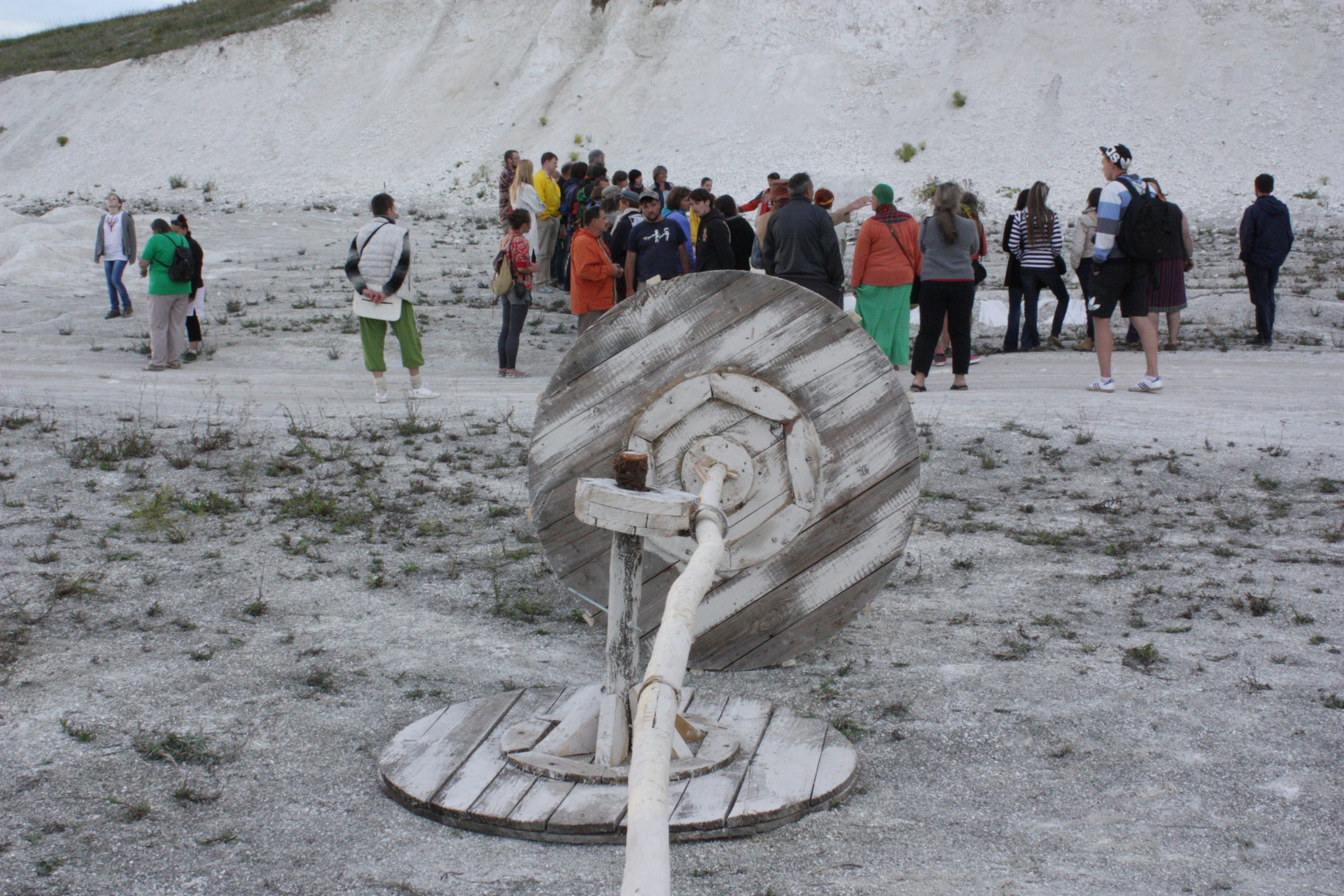
Mohrytsia Symposium: 27 Years of Ukrainian Land Art

Project presentation, 2016
©Roman Klymenko
Until now, we have written extensively about the practices of Ukrainian cultural actors after February 24, 2022 — the beginning of Russia’s full-scale invasion of Ukraine. This time, we spoke with artist and coordinator of the Mohrytsia Land Art Symposium, Yehor Antsyhin.
Over its 27 years of existence, Mohrytsia has evolved from a local art initiative into a creative laboratory that has shaped an entire generation of artists working with landscape, memory, and the relationship between place and human presence. Located near a chalk quarry just a few kilometers from the Russian border, the symposium has been directly affected by the war.
Read our interview to learn how the project was born, how it transformed over time, and how it exists today.
Office Ukraine: The Mohrytsia Symposium has existed for 27 years. Could you briefly tell us how and where it all began? Why the Sumy region and the chalk quarry? Was the reference to Robert Smithson intentional from the beginning, or did it emerge later? And why specifically a land art symposium?
Yehor Antsyhin: The land art symposium originated from summer student practices of the Sumy Art College, set within the diverse landscape near Mohrytsia — including an ancient Severian hillfort, the chalk quarry, meadows, hills, and the Psel River. From the outset, this environment created a multilayered context for artistic work and became a center for spatial experimentation and interdisciplinary exploration.
The plein air format quickly evolved from a purely educational model into an intergenerational space where young artists worked alongside established practitioners.
Mohrytsia’s land art is intuitive, though conceptually grounded. The curators and artists were well aware of the international art context. They knew the practices of Richard Long, Robert Smithson, and other land art pioneers. Yet what became essential was the continuity of inhabiting this place — a movement from object toward process and interaction. This is the core of the symposium. In this way, the Mohrytsia community formed, significantly shaping the direction of the symposium, which was continuously rethought and structured by its curators.
If I return to the question of what the symposium was and remains about, for me the answer lies in building community and long-term connections among artists through their shared engagement with the Mohrytsia landscape.
OU: Over 27 years, the social and political landscape — not to mention the natural one — has changed dramatically. From the late 1990s, the early years of independence, through different phases of Ukrainian democracy, Maidan, the occupation of Crimea, and Russia’s invasion — how were these changes reflected in the symposium’s program and curatorial approach?
YA: The symposium site is located just three kilometers from the Russian border. Until 2013, Russian artists participated in the symposium, and representatives of neighboring district administrations attended final events.
After 2014, themes of borders, division, and identity began to appear in the artists’ works — it could not have been otherwise, when tanks were already stationed on the dirt roads around Mohrytsia on the Russian side.
Over 27 years, artists and approaches to landscape and material evolved. A detailed analysis of specific works from each period would require a separate discussion. Generally speaking, however, there was a gradual shift from predominantly poetic and metaphorical gestures toward more socially and politically sensitive statements. Importantly, these directions did not replace one another but layered over each other, making the practice more multidimensional.
From 2014 to 2024, works emerged that directly responded to key historical events in Ukraine. The symposium archives contain works that engage in direct dialogue with political context. Yet it is important to remember: land art is primarily an art of relationships with the natural environment. This principle often guided artistic exploration.
In summary, the symposium evolved from a plein air format into a full-fledged institution — a network of artistic laboratories united by space, time, and the desire for collaborative work and knowledge exchange.
The symposium program was never a direct mirror of political events. The curatorial approach responded rather to developments within the artistic field: what themes artists were exploring, how communities communicated, and what forms of collaboration became possible.
A significant shift occurred from single-curator models to networks of curatorial groups and horizontal connections, allowing participants to be structured by artistic positions and approaches. The symposium titles often outlined broad frameworks — of space, time, and relationships.

A group of students from the Sumy Art College – preparing ceramics before firing, 1997
© Hanna Ghidora
OU: Each year looked different. Artists had time to create works and engage with the environment, and later audiences could experience them. How long did artists typically work? Were there residencies? Was there time for long-term research projects?
YA: The symposium functioned almost always as a residency. On average, artists were given two weeks to work, though they could arrive earlier or stay longer, and some projects lasted a month.
Some works were oriented toward long-term observation — tracking changes under natural conditions. Certain pieces existed for years, gradually transforming or disappearing into the landscape.
OU: How did the symposium and artists collaborate with local residents? Were they involved at different times? How did non-art audiences respond?
YA: Interaction with local residents lasted throughout the symposium’s existence and went through various stages. The district administration and community assisted with organizational matters — from water and firewood to permits and press coverage.
The local school initiated research projects about Mohrytsia land art and trained student guides. Residents of Mohrytsia and nearby villages attended final presentations. Two community members even started a small tourism business offering guided tours of the symposium site.
Local traditions emerged: visitors left ribbons, created small objects, or threw coins into the center of certain works. In different years, artists involved residents directly in their projects.
Since the 1950s, this area had been used for celebrating Ivan Kupala. The revival of cultural activity was seen as a continuation and transformation of tradition. Over time, the community began to perceive the symposium not as entertainment but as a philosophical and artistic event, engaging in discussions and attentively listening to presentations. Media coverage and Mohrytsia’s gradual formation as a cultural tourism site also played an important role.
OU: Over 27 years, a whole generation of artists has grown up. Can we speak of a distinct Mohrytsia aesthetic or community?
YA: The symposium became an active laboratory for developing young artists and new approaches to working with the environment. It shaped several generations who later became active participants in the Ukrainian art scene, for whom land art experience was formative.
For many, Mohrytsia was not merely a location but an initiation into art — a moment of self-discovery and moving beyond academic canon.
Living and working side by side, engaging in discussions, formed not only social bonds but also a recognizable visual language. Within this chalk landscape, a shared understanding of land art — and contemporary art more broadly — crystallized.
Most artists returned repeatedly to work with this space over many years.
OU: How has the geography of participants changed? With which land art centers in Ukraine did you collaborate?
YA: From a group of 20 artists and students from Sumy, the community expanded to 103 participants from across Ukraine — Kyiv, Kharkiv, Lviv, Vinnytsia, Dnipro, Zaporizhzhia, Chernivtsi, Uzhhorod, Poltava, Chernihiv, and others — becoming a national platform for land art development.
Presentation days attracted up to 1,000 visitors from across Ukraine and abroad.
We regularly organized exhibitions, annual catalogs, and video documentation, spreading information about the symposium’s activities. At various times, land art events took place in Kyiv, Zaporizhzhia, Lviv, Odesa, the Carpathians, Poltava, and elsewhere, where we participated through consultations, lectures, presentations, and artist involvement.

Natalia Lisova. PATH: INTERACTION, Happening, 2021
©Oleg Demyanenko
OU: The war has changed everything. The symposium is no longer held in the Sumy region. How can Mohrytsia continue under such conditions?
YA: Today, the site is partially mined and under shelling, making it inaccessible. But Mohrytsia has always consisted of two components: place and community. Our main task is to preserve connections, memory, and accumulated experience.
In 2023, we realized the project Internally Displaced Landscape, taking place simultaneously in Sumy, Kharkiv, Lviv, and Kyiv. The structure remained, but meetings were online. Each city had its own curator, and presentations, exhibitions, and a catalog were produced.
In 2024, projects were presented in Vienna and Sumy. The key initiative was SEE:UA — Connecting Landscapes, a dialogue between public art practices in Vienna’s Notgalerie and the land art practices of Mohrytsia. Borderland Space, temporarily deprived of its primary location due to the full-scale invasion.
From June to November 2024, SEE:UA connected Ukrainian and Austrian landscapes and cultural communities, exploring Seestadt’s transformation from fields to construction site to new district, and reflecting on how experiences of war and inaccessible landscapes might be translated elsewhere.
In 2025, the focus shifted to developing the online archive Borderland Space, alongside public events in Lviv, Kyiv, and Sumy.
OU: What are the current goals and needs of the organizers?
YA: Our primary goals are preserving the community and its legacy, and developing the archive. We dream of publishing a comprehensive online-album and creating a research-exhibition project on land art in Ukraine. We aim to continue land art practices in new locations while preserving the values of Borderland Space.
We are searching for new forms for the symposium’s future. With proper funding, we are ready to expand and sustain the institution’s activities.
OU: Is there anything you would like to add?
YA: I would like to express special gratitude to chief curator Hanna Volodymyrivna Gidora, who is the foundation and ground of this major project, and to Natalia Matsenko, who consulted me while preparing these responses.
We send warm greetings to all participants and viewers of the land art symposium and remind you that we remember you. As soon as we are able to hold a new symposium, we will be happy to welcome everyone back into our wide circle.