
Office Vienna
/
Rot-Weiß-Rot – Karte Plus
/
A New Path for Displaced Ukrainians in Austria
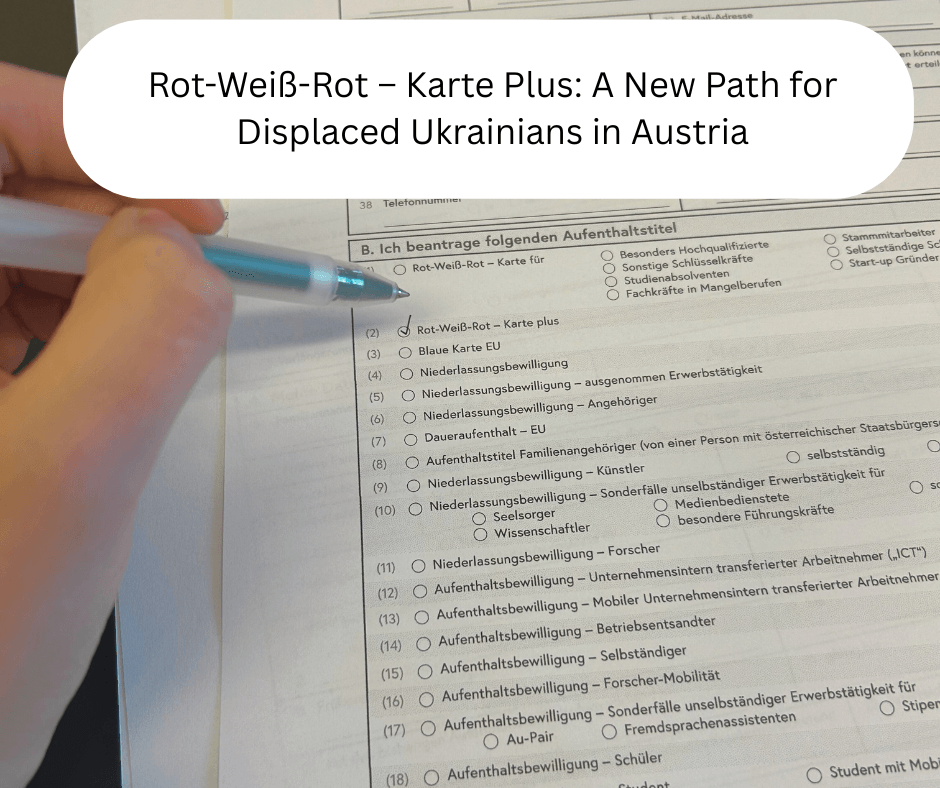
As of early 2025, Statistics Austria reports 87,927 Ukrainian citizens living in Austria. For some, the Rot-Weiß-Rot – Karte Plus (RWR+ permit), introduced on 1 October 2024, opens a way toward more stable residency — and eventually, a permanent EU residence status.
/
What is the Rot-Weiß-Rot – Karte Plus?
The Rot-Weiß-Rot – Karte Plus is a residence permit under the Austrian Niederlassungs- und Aufenthaltsgesetz / NAG (in English: Settlement and Residence Act). It provides a different and more long-term form of residence than the temporary protection document (Ausweis für Vertriebene) currently held by displaced Ukrainians.
Holders of the RWR+ enjoy unrestricted access to the Austrian labour market — whether employed or self-employed and the RWR+ residence qualifies as settlement in Austria. After five years, holders may qualify for Daueraufenthalt – EU if all statutory requirements are fulfilled. For applicants who obtained the RWR+ as employed/self-employed persons, immediately preceding periods under temporary protection can also count as settlement for this purpose.
Importantly, displaced Ukrainians can continue to live and work in Austria under temporary protection without switching to the RWR+. The temporary protection status currently applies until 4 March 2027.
/
Who Can Apply
To transition from displaced status to the Rot-Weiß-Rot – Karte Plus, several key conditions must be met:
• Recognised displaced status: Applicants must hold the Ausweis für Vertriebene (“blue card”) and have the corresponding temporary right of residence.
• Employment and insurance: At least 12 months of full social insurance coverage (employment or self-employment) within the last 24 months in Austria, with insurance under ASVG or GSVG. The periods do not have to be consecutive.
• Important for self-employed artists: Self-employed persons must have been fully insured under the GSVG. For employees, the relevant threshold is the monthly marginal-earnings threshold; for self-employed persons, the relevant insurance threshold applies.
• German language skills: Applicants must generally provide proof of A1-level German or proof that they fulfil the relevant requirements of the Integrationsvereinbarung. For the RWR+, Module 1 of the Integrationsvereinbarung must be fulfilled within two years if it has not already been fulfilled.
• Secured livelihood: Applicants must demonstrate sufficient income or assets to support themselves without becoming a financial burden on Austria. Applicants receiving Grundversorgung do not meet this requirement.
• Accommodation: Applicants must also demonstrate a legal entitlement to appropriate accommodation, for example through a rental agreement, sublease, service accommodation or Wohnrechtsvereinbarung.
• Valid passport and no serious criminal record: A valid travel document is required, and the applicant must not pose a threat to public order or security.
• Valid displaced person card at the moment of application.
/
How Much Income Is Enough?
For 2026, the relevant NAG/ASVG guideline rates are:
Single person: €1,308.39 net per month
Married couple / registered partners: €2,064.12 net per month
Each child: an additional €201.88 per month
Housing costs, loan repayments and other regular financial obligations are taken into account. A one-time amount of €386.43 — the 2026 value of “freie Station” (free accommodation) — may be deducted from such costs.
Example using the 2026 figures: A single applicant with €500 monthly housing costs would generally have to demonstrate an income sufficient to meet the €1,308.39 monthly guideline rate after the legally relevant deduction for housing costs. The exact amount cannot simply be calculated by adding the full rent to the guideline rate, because the “freie Station” deduction is taken into account. Assets/savings may also be relevant when assessing whether the livelihood is secured.
Savings, sponsors’ declarations, or “free accommodation” (e.g., living rent-free with friends or family) may be relevant, but the authorities assess the applicant's overall financial situation under the NAG. A legally valid right to accommodation must also be demonstrated.
/
Artists and Self-Employment
Some Ukrainian artists working independently in Austria are now eligible for the RWR+ permit. They must provide:
• An insurance data extract from SVS (for self-employed artists).
• Proof of being insured for at least 12 out of the last 24 months.
• Evidence sufficient to establish the applicant’s income and secured livelihood. For self-employed persons, the authorities examine the individual financial circumstances; income-tax assessments and other financial documents can be useful evidence.
• Irregular self-employed income is not automatically excluded; the decisive question is whether the applicant can demonstrate a secured livelihood under the applicable NAG requirements.
• The first RWR+ is normally issued for one year. If the person has already been continuously settled for at least two years and fulfils Module 1 of the Integrationsvereinbarung, the RWR+ is issued for three years. The validity can also be limited by the validity of the applicant’s passport.
/
How Long Does It Take?
The competent settlement authority processes the application under the applicable NAG rules. The specific processing time can vary considerably depending on the authority and the individual case. A general statement that applications are normally completed within one to three months should therefore not be presented as an official processing time.
The application requires the general conditions under the NAG to be fulfilled, including secured livelihood, appropriate accommodation, comprehensive health insurance and compliance with public-order and security requirements.
/
Why It Matters
For thousands of displaced Ukrainians who have been living, working, and integrating in Austria since 2022, the Rot-Weiß-Rot – Karte Plus represents a crucial step toward long-term security.
It acknowledges both their contribution to Austrian society and their desire for stability after years of uncertainty — turning temporary protection into a pathway for a sustainable future in Europe.
The RWR+ is not mandatory. Displaced Ukrainians can continue to reside and work in Austria under temporary protection, currently until 4 March 2027. The advantage of the RWR+ is that it provides an independent, renewable residence title and can establish a pathway toward Daueraufenthalt – EU after five years if the statutory conditions are fulfilled.
/
Useful links
Federal Ministry of the Interior (BMI) – Information on switching to the Rot-Weiß-Rot – Karte Plus
Austrian government – Information for Ukrainian nationals
Statistics Austria – Population by citizenship/country of birth
Austrian Integration Fund (ÖIF) – German language exams
Austrian Social Insurance (ÖGK/SVS)
(Text updated in August 2026)