
Office Vienna
/
I was a bit naive about how long the war would last
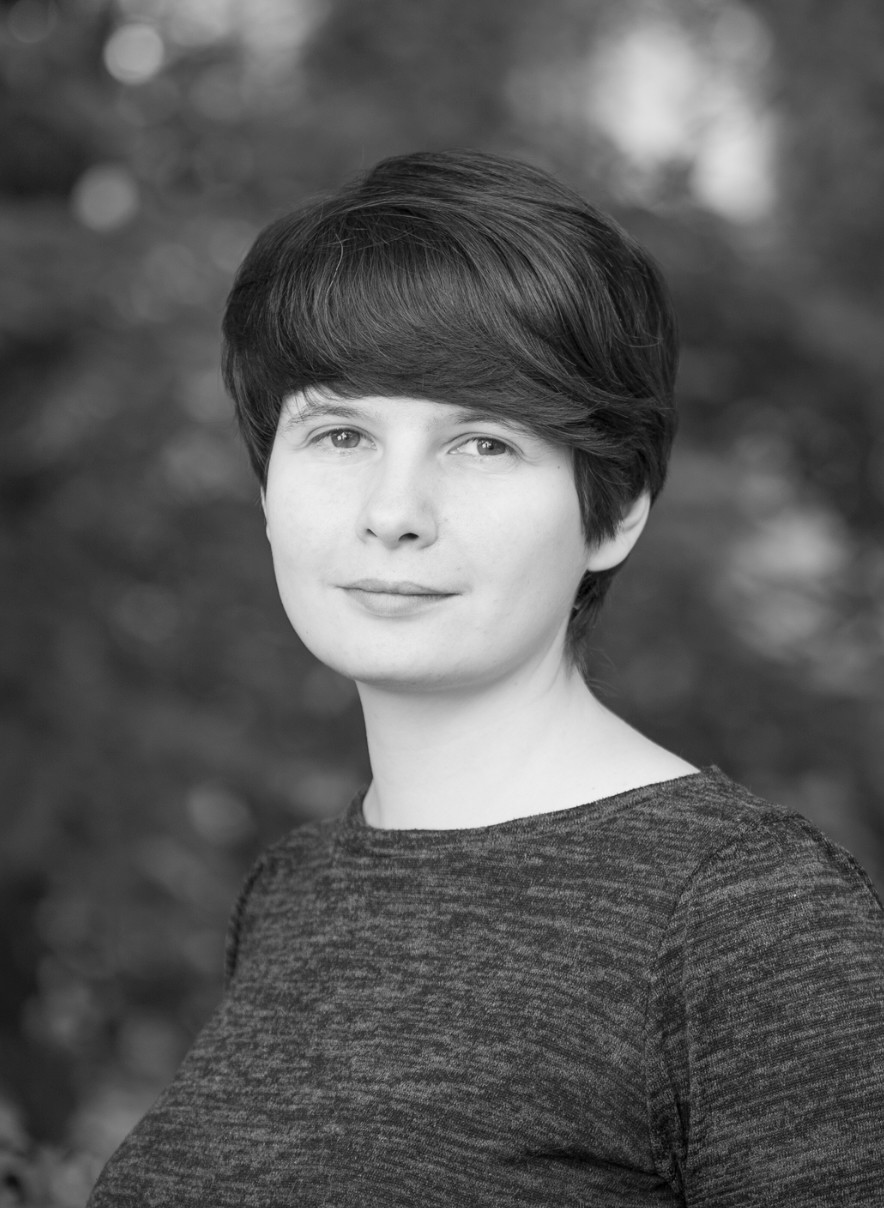
The solidarity project “Can you see what I see” was organized and curated by Anastasiya Yarovenko, a Vienna-based Ukrainian artist and curator, who invited five artists from Ukraine to participate. The Lentos Art Museum in Linz and the BMKÖS generously supported the project, making it possible to present the works in public spaces and in the museum’s foyer during the summer months.
Anastasiya Yarovenko shared with us her personal reflections on the project and on art in times of conflict. Through collaboration with artists from Ukraine, the project aimed to shed light on the creative forms of expression in a region marked by a severe crisis. The support of the Lentos Museum and the BMKÖS played a decisive role in bringing this concept to life and making the artworks accessible to a broad audience.
/
Office Ukraine: How did you come up with the idea for this project? What was it about, and what target audience did you want to reach?
Anastasia Yarovenko: On February 24, 2022, the lives of all Ukrainians, both inside and outside Ukraine, changed abruptly when Russia invaded Ukraine, thereby escalating the war that had begun in 2014, which would ultimately lead to thousands of deaths and the largest refugee crisis in Europe since World War II. I spent the first few months volunteering around the clock: sending medications, helping with evacuations, finding apartments in Austria, and translating many texts and documents. At some point, I realized that there were already many volunteers working on similar tasks, but not much was happening in the area I’m familiar with. It was important to make a visible statement. The news continued to come in fast and furious, and most people on the ground had grown accustomed to the situation; it was no longer a shock, even though the war isn’t over yet.
In April 2022, I contacted Hemma Schmutz, the director of the Lentos Art Museum in Linz, and proposed a solidarity project. Two months later, with financial support from the BMKÖS and the fantastic Lentos team, we were able to open an exhibition that was accessible to everyone throughout the summer of 2022. When I was thinking about the intervention in April 2022, I had been naive enough to believe that by the time the exhibition opened in June, we would no longer have to talk about the war, its consequences, and the reconstruction plan. But even now, 1.5 years later, we don’t know when this catastrophe will end.
/
OU: How did you select the artists you invited? Had you worked with them before?
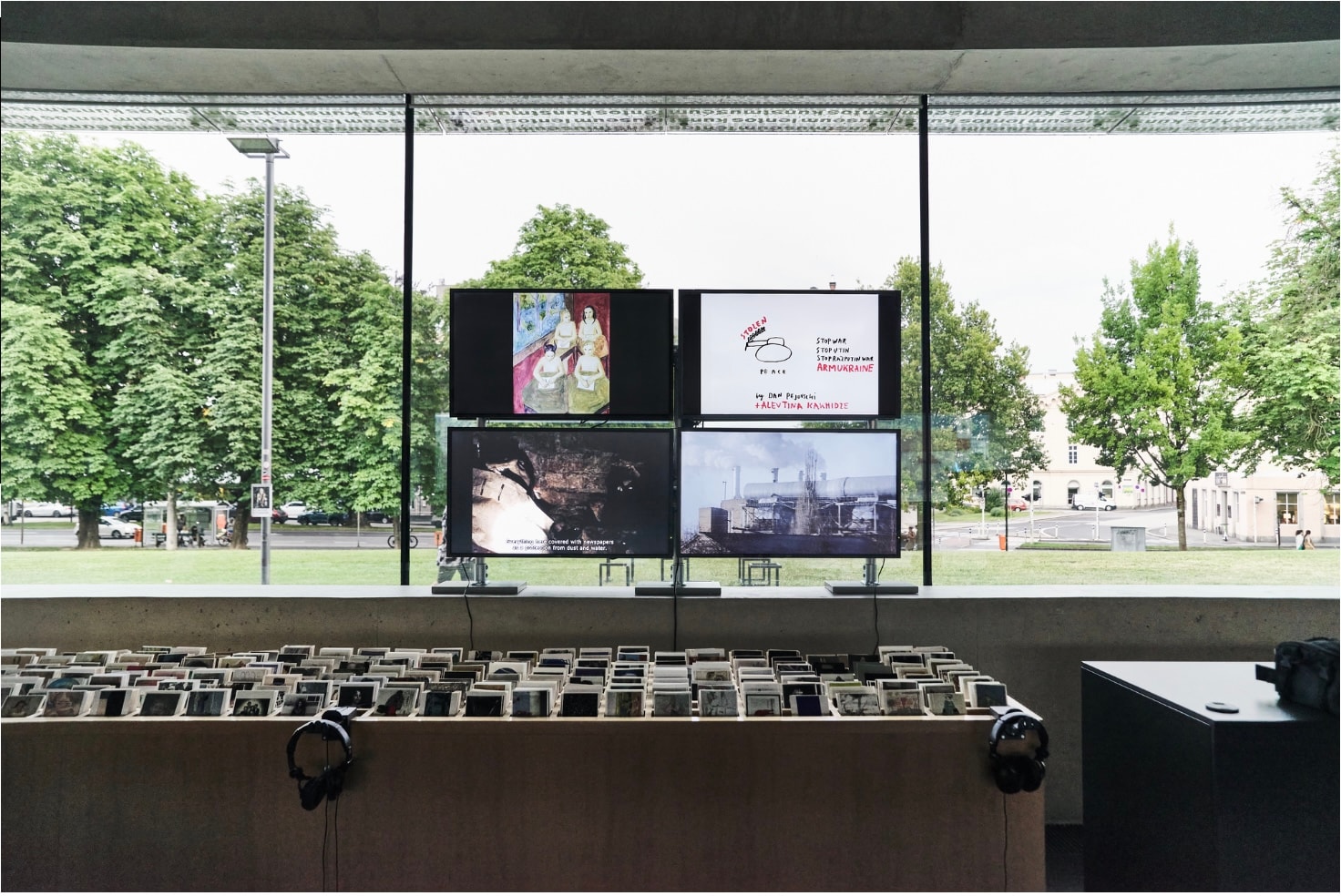
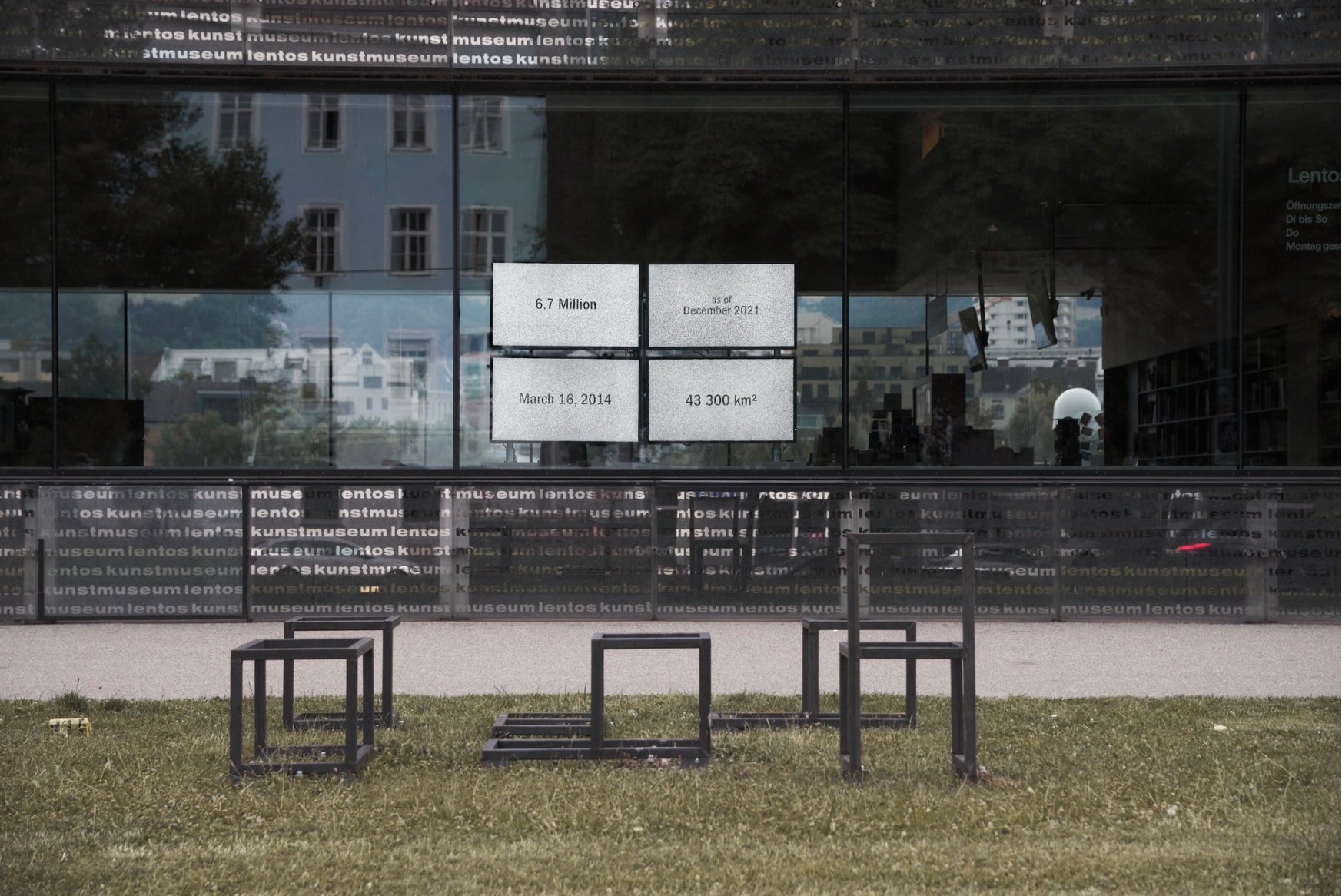
AY: “Can you see what I see” was a response to the rapidly changing situation in Ukraine and a show of support for Ukrainian artists affected by the war. Some of the selected artists were in Austria and some were in Ukraine, since male artists of military age are not allowed to leave the country. The program consisted of an installation in public space outside the museum and a presentation in the foyer featuring videos, films, and drawings that relate both to the current situation and to the situation in Ukraine since the first Russian invasion of Ukraine in 2014. I have known most of the participating artists for many years. Alevtina Kakhidze, who is known for her illustrations about the war in eastern Ukraine, has prepared a slideshow featuring drawings about the West’s reaction, Russian culture and its “attention-seeking” gestures, and Ukraine and its cultural front during the war.
I met Kateryna Lysovenko in Vienna, where she has been living since the start of the war. The works on display are from the artist’s latest series, which she developed during Russia’s open aggression against Ukraine. Resistance, willpower, and the attainment of true strength are the central themes of this series. I studied under Oleksiy Radynski in Ukraine and have been following his work for quite some time. His 2020 film “Circulation” documents Radynski’s three-year observation of the changes in the landscape around Kyiv. Mykola Ridnyi presented two short films. The main subject in “Shelter” is an underground bunker that has been repurposed as a kind of military training school. In modern Ukraine, many nuclear bunkers from the past have since been decommissioned. Some have been repurposed to serve new functions, adapted to different needs through individual creativity. For the short film “Father's Story,” Ridnyi asked his father to take a video tour of the basement beneath the house in the countryside where his family used to live. Both films were shot before the large-scale invasion, but they deal with a new Ukrainian reality.
/
OU: How did the audience react to the project?
AY: The preparation helped me stay sane and focused, since the time available for implementing the project, applying for grants, and organizing for the opening day was relatively short. After reading the news the evening before the opening about Russia’s increasing destruction in Ukraine, I thought that the scale of the intervention and all the artistic and curatorial efforts were ridiculous in light of the war and the losses. I felt helpless and lost. The day after the opening and the press conference, many Upper Austrian and Salzburg media outlets wrote about it. It was a small victory. It’s not easy to get any coverage at all for such a difficult topic. The museum’s location and the nature of the exhibition allowed thousands of passersby and visitors to view the works of Ukrainian artists for free and with minimal barriers to access. The banks of the Danube in Linz are very popular in the summer, so the intervention gained a lot of visibility as a result.
/
OU: What was your experience collaborating with a major art institution during an emergency?
AY: What I appreciate most about this particular project is Lentos’ flexibility. For such a large institution with a busy program, an unscheduled project means an additional investment of resources and time. I am grateful that Hemma Schmutz and the museum team supported Ukrainian artists during such a difficult time by providing a space for art and showcasing the Ukrainian contemporary art scene, which is underrepresented in Western Europe.
/
OU: Please tell us a little about yourself: Where are you from, and what kind of artistic work do you do?
AY: As an artist, I am interested in objects, in surfaces that transform into spaces, while spaces become grids for reality. “Space” is understood in many ways. Whether these are physical or imaginary spaces, temporary situations or political contours, whether they are site-specific situations or states of mind. My work explores space as a situation, as a material gesture, as a collective image. Between form and function, between space and dimension, it creates specific possibilities and associations. The norms that define the space we claim as human beings are also what I focus on as I approach the idea and concept of the norm in society. I’m talking about “being normal” and this term that is constantly used to describe our world, but which equally restricts and categorizes us. In art circles, there are many discussions about the power and powerlessness of art in the face of war.
/
OU: What is your opinion on this? What can art and artists do in these brutal times?
AY: There are times when we all feel powerless; the constant news of death and destruction affects us on every level of our lives. Some find solace in creating art, as best they can, while others are completely speechless and remain silent. There is no formula for what art can achieve in these times. Art has existed in many forms during many wars throughout history, but most of us have never truly experienced war firsthand. Each of us is going through our own process of coming to terms with and coping with it.
Anastasiya Yarovenko
artist and curator, lives and works in Vienna. She studied at the Academy of Fine Arts Vienna (2015) and holds an MA in Literary Theory and Comparative Studies (2006) from the Kyiv – Mohyla Academy. Anastasiya has participated in several biennials, including the School of Kyiv – Kyiv Biennale (UA) in 2015. She has been awarded several art awards, including the Kunsthalle Wien Prize, the START Fellowship from the Federal Ministry of Culture, and the MAK Schindler Scholarship Program (USA). Her works have been featured in international exhibitions such as the Lentos Art Museum in Linz (AT), xhibit (AT), Köttinspektionen in Uppsala (SE), Sculpture Park, MuseumsQuartier Vienna (AT), Württembergischer Kunstverein, Stuttgart (DE), Mackey Apartments, Los Angeles (USA), Kunsthalle Wien (AT), Odessa Museum of Western and Oriental Art (UA), Nest (NL), and others.
/
Photos: Reinhard Haider, Richard Zazworka