
Office Vienna
/
Fighting stereotypes and finding your voice: Internship at the Kunsthistorisches Museum
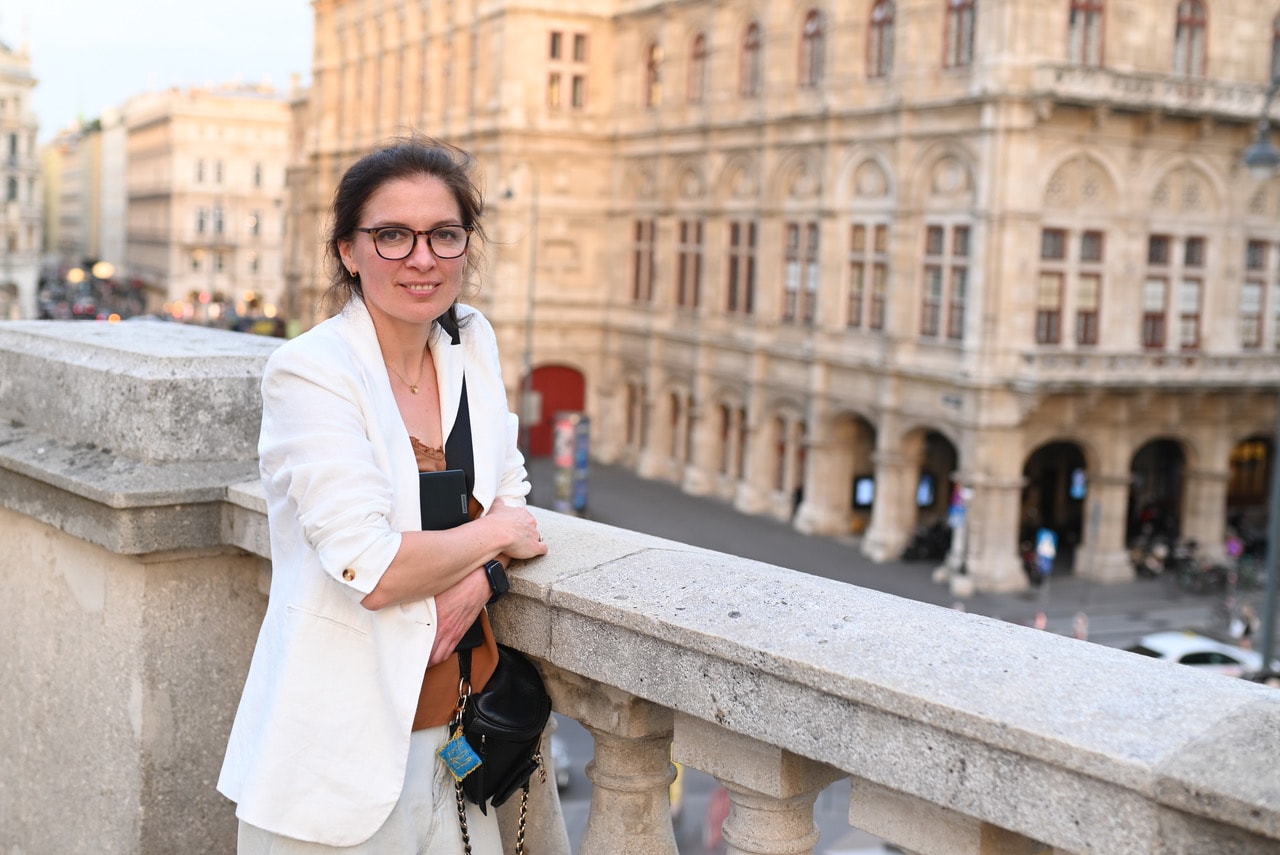
In winter, Kateryna Kinsel started her internship at the Art History Museum in Vienna. The internship is a result of a cooperation between the Artists Solidarity Program Europe (ASoP Europe) supported by the Austrian Foreign Ministry, Kunsthistorisches Museum Wien, and Office Ukraine. We talked with Kateryna to learn more about her life and her experience at the renowned Austrian museum.
/
Office Ukraine: Kateryna, please tell us more about your background.
Kateryna Kinsel: Before the full-scale invasion, I lived in Kyiv. I worked as a corporate lawyer for 15 years, but according to statistics, a certain number of lawyers later switch to the art field, and I was one of them.After the birth of my two daughters, I decided to organize everything I had learned about thousands of paintings and hundreds of books and to pursue a proper education in art history. In 2021 I graduated from the National Academy of Fine Arts and Architecture in Kyiv with a master’s diploma, considering an interesting art opportunity to start my new profession. But the war of Russia against Ukraine destroyed all my plans.
/
OU: How has Vienna influenced you in terms of artistic interests?
KK: Vienna is a dream place for an art historian.It was a great comfort to find a sense of security in this city. From the very first days, I immersed myself in everything related to art in Vienna, visiting every possible museum and exhibition, but also participating in volunteer projects for Ukrainian refugees.I developed a series of lectures on the most remarkable periods of Ukrainian art for women supported by the non-profit organization “Domivka.” I gave several guided tours through Albertina for Ukrainian scholars cooperating with WU. I started giving lectures on art for Ukrainian students. All these volunteer activities gave me an opportunity to share my knowledge and passion for art, while also giving me a sense of purpose and keeping my mind active through these challenging times.
Later I started giving guided tours in Belvedere, Secession, Albertina and other art institutions. Currently, I’m working as an art historian teacher with the Free People School. My students are lucky to learn from the original works of the best European and American artists. On the other hand, it is a challenge for me to explain why artists like Markus Lüpertz and Fernand Léger are considered cool and why. I would like to mention the exhibition “In the Eye of the Storm” at Belvedere. I am grateful to Belvedere and all the people involved for organizing this comprehensive exhibition, as well as I was very happy to see how many Ukrainians were eager to learn about Ukrainian modernism.
/
OU: How did you learn about the internship at KHM, and what are you doing there?
KK: I applied for an ASoP Europe grant with an internship at the KHM through Office Ukraine, sent my CV and cover letter, and finally received a letter from the KHM congratulating me on winning the internship. The goal of the internship was to translate the KHM audio guides from English into Ukrainian, as the current audio guides cover only a limited number of artworks. My first meeting with Dr. Helga Rabl-Stadler and Mr. Mraz running the ASoP Europe Program commissioned by the Austrian Foreign Ministry was indeed friendly and supportive. Then I met the members of KHM team, who were kind as well. Alexander Smith and David Schreier from the KHM’s audio-guide department have been very helpful during my translation work.
So far, I have completed the translation of all the audio guides, including those for the Gemäldegalerie, the Kunstkammer, and the Egyptian, Greek, and Asian collections. The final stage of the internship is the voice-over, I hope it will be finished soon and Ukrainians will enjoy visiting the KHM much more.
/
OU: What is important to you in this project?
KK: There are two main significant aspects for me related to this project. First, there is the exciting possibility that Ukrainians will soon be able to learn about the masterpieces of the KHM in their own language. Second, and no less importantly, this project allows the KHM and Austria to show empathy and solidarity with Ukrainians, which is especially meaningful during these difficult times.Of course, I have grown professionally through this internship, which I find incredibly rewarding.
/
OU: What are the differences between museums here in Austria and Ukraine?
KK: The main difference is the size of the collections. As the capital of the Habsburg monarchy and later the Austrian Empire, Vienna accumulated an enormous number of outstanding works of art from all over the world, many of which are still preserved in its museums today. The history of Ukraine shows that Ukrainian art started from the 12th century till now was and is being looted or destroyed.The priceless collections of Ukrainian art patrons such as Tereshchenko and Khanenko met a similar fate. Today’s war has deprived Ukraine of even more of its cultural heritage: the Crimean museums and museums in Donetsk and Luhansk regions, the Kherson Art Museum, the Kuindzhi and Skovoroda Museums, the Maria Prymachenko Museum, and many-many others have been appropriated, looted, or destroyed by Russians. My wish for Ukraine is to see all its looted cultural heritage returned to its museums, from the mosaics of St. Michael’s Golden-Domed Monastery to ancient icons dating back to the 11th and 12th centuries. I dream of a future in which Ukrainians can enjoy and study art history in the museums of Kyiv and in museums in their hometowns.
/
OU: Did you have any stereotypes about Austria before coming here?
KK: The main stereotype is that Austrians are arrogant and unfriendly. This is not true, at least I do not see these traits as common. On the contrary, the Austrians whom I met during these two years are very open and helpful, and I am very grateful for that.